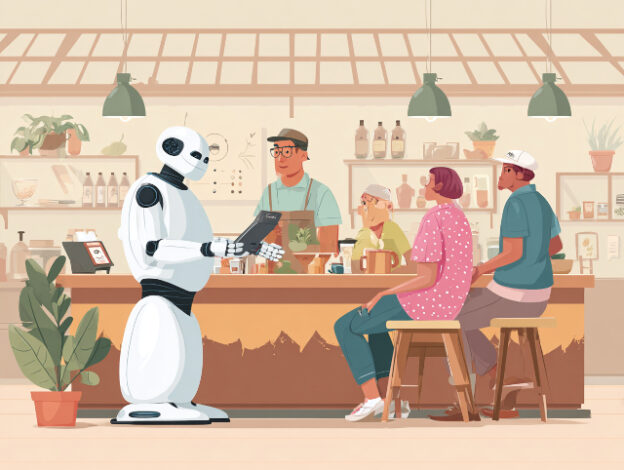
When shopping online, many of us now take for granted that the first “person” we interact with is not a human being at all. A chatbot answers our questions about delivery, a virtual assistant keeps us updated on our parcels, and an AI system calmly manages the process of returning items. This seamless reliance on digital service has become so routine that we may no longer question it. Yet one pressing question remains: does it really matter to us whether a person or a machine handles our customer service experience?
A sweeping new international meta-analysis suggests the answer is more complicated than conventional wisdom implies. Contrary to the widespread assumption that customers overwhelmingly prefer human representatives, artificial agents are often received more positively than expected. They are not necessarily viewed as superior to their human counterparts, but the gap between the two is much narrower than many would predict. This conclusion emerges from an impressive synthesis of 327 experimental studies involving nearly 282,000 participants, conducted by Professor Holger Roschk of Aalborg University Business School, in collaboration with Katja Gelbrich, Sandra Miederer, and Alina Kerath from the Catholic University of Eichstätt-Ingolstadt. Their findings were published in the Journal of Marketing.
One of the most striking insights is that AI agents may excel in circumstances where human interaction feels awkward or uncomfortable. When shopping for health-related or intimate products, for instance, many customers prefer the discretion of a digital interface to the potential embarrassment of speaking face-to-face with a person. Similarly, artificial agents can be especially effective in situations where they must deliver unwelcome news. Roschk notes that when an algorithm rejects a loan application, customers may find the machine’s unemotional, “insensitive” manner less distressing than a human’s rejection, which might feel more personal.
The researchers emphasise that context plays a decisive role. AI systems are not universally better or worse than people; their effectiveness depends on the nature of the task at hand. Algorithms, for example, excel at logistical challenges such as calculating routes, estimating waiting times, or recommending clothing sizes based on previous purchases. Robots with physical capabilities, meanwhile, have a clear edge in roles that require motor skills and repetitive labour, such as hotel room service or warehouse operations. In these areas, the efficiency of machines can surpass human performance, while freeing employees to focus on responsibilities that require creativity or empathy.
At the same time, the limits of artificial agents are stark. Technology cannot yet replicate the spontaneity, warmth, or nuanced situational awareness that humans bring to many service encounters. In scenarios where emotional intelligence and genuine empathy are indispensable—such as healthcare consultations, sensitive complaints, or complex negotiations—human representatives remain irreplaceable. Roschk stresses that the goal is not to supplant people with technology but to deploy machines strategically, in areas where they provide relief from repetitive or emotionally taxing tasks.
This nuanced perspective marks a significant shift in the broader discussion about AI in everyday life. Instead of asking whether customers prefer humans or machines, the research invites us to think more carefully about when and why different agents are appropriate. If organisations can identify contexts where AI adds value without undermining the human touch, they may not only improve efficiency but also enhance customer satisfaction. As Roschk concludes, the debate is not about replacing people, but about recognising where machines can best complement human service—and where the uniquely human qualities of empathy, care, and intuition must remain firmly in place.
More information: Holger Roschk et al, Automated Versus Human Agents: A Meta-Analysis of Customer Responses to Robots, Chatbots, and Algorithms and Their Contingencies, Journal of Marketing. DOI: 10.1177/00222429251344139
Journal information: Journal of Marketing Provided by Aalborg University