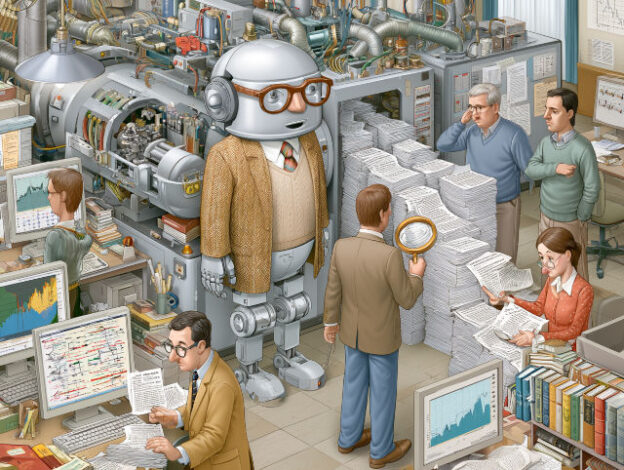
Artificial intelligence (AI) and large language models (LLMs) can mass-produce academic finance papers that are nearly indistinguishable from human-authored research, according to a new study published in the Journal of Economic Literature. Researchers Mihail Velikov of Penn State and Robert Novy-Marx of the University of Rochester developed an automated pipeline capable of generating hundreds of publication-ready finance papers in a matter of hours.
The project originated from a data-mining exercise examining corporate accounting data for signals that could predict stock performance. After identifying more than 30,000 potential signals and comparing them against 200 previously documented anomalies in the finance literature, the researchers narrowed the list to 95 genuinely novel signals.
Velikov created a website that automatically generated template reports describing each anomaly. While the reports resembled academic papers, they lacked theoretical explanations. Recognising the growing capabilities of LLMs, the researchers turned to AI to generate hypotheses and narratives explaining why the anomalies might exist.
Using Anthropic’s Claude Opus model, the researchers instructed the AI to assign descriptive names to the predictors and produce four distinct manuscripts for each signal, each offering a different theoretical explanation. In total, the system generated 380 complete papers, including abstracts, introductions, methods, results, conclusions and citations. The papers and code were subsequently made publicly available.
The study highlights both opportunities and challenges for academic research. As AI dramatically lowers the cost and time required to produce scholarly manuscripts, it could further increase submissions to journals and conferences, placing additional strain on an already burdened peer-review system. Velikov argues that research evaluation and dissemination practices will need to adapt to the growing role of AI-generated scholarship.
The researchers also raise concerns about “HARKing” — hypothesising after results are known. In the AI-generated papers, hypotheses were created only after patterns had already been identified in the data, raising questions about scientific contribution, research integrity and the role of theory in knowledge creation. Although Velikov does not believe AI will replace researchers, he expects it to fundamentally transform how research is conducted, evaluated and communicated across finance and many other academic disciplines.
More information: Robert Novy-Marx et al, Artificial Intelligence–Powered (Finance) Scholarship, Journal of Economic Literature. DOI: 10.1257/jel.20251821
Journal information: Journal of Economic Literature Provided by Penn State