Tag Archives: forest resources

Research Highlights Environmental Consequences of Growth Driven by Multinational Companies

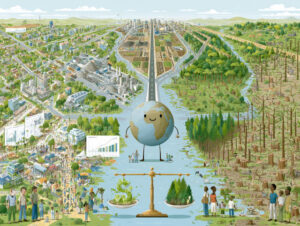
Multinational companies can boost local economies but often come with higher environmental costs than domestic firms, according to new research by Dr. Frederik Noack, associate professor in the Faculty of Land and Food Systems at the University of British Columbia, published in the journal Nature Climate Change. Drawing on data from across Africa, the study found that multinational activity is associated with greater deforestation and biodiversity loss, even as it contributes to economic growth.

The research addresses a long-standing debate about the role of multinational firms in developing economies. While these companies are often credited with bringing investment, employment opportunities and new technologies, critics have argued that they may relocate environmentally harmful activities to countries with weaker environmental regulations. A key challenge has been determining whether multinational firms directly cause environmental degradation or operate in areas where such impacts are already occurring.

To isolate the effect of multinational activity, the researchers tracked firms through their global networks. They examined how changes affecting company headquarters, such as shifts in access to credit, influenced expansion abroad. Because these changes were unrelated to local environmental conditions, they provided a unique opportunity to identify the environmental consequences of increased multinational activity while controlling for other factors.

The findings reveal a clear relationship between multinational expansion and environmental degradation. Using data that linked millions of firms to satellite measurements of forest cover and land use across Africa, the study found that areas experiencing greater multinational activity saw approximately 24 per cent more deforestation and notable declines in forest cover. The researchers also observed a 0.6 per cent reduction in crop diversity, an important indicator of biodiversity and food security. These environmental impacts persisted over time rather than disappearing after initial development.

At the same time, multinational firms generated measurable economic benefits. Each new multinational affiliate was associated with an increase in local GDP of roughly 0.3 per cent, equivalent to about $106 million. However, the environmental costs were substantial. The average forest loss linked to an additional affiliate amounted to approximately 10,200 hectares. When carbon emissions and related damages were considered, the estimated environmental cost reached about $693 million—several times greater than the economic gains.

The study also found that multinational firms have a significantly larger environmental footprint than domestic firms, even after accounting for differences in size and activity. This is partly because multinational companies are more heavily concentrated in sectors such as mining, large-scale agriculture and manufacturing, which have substantial impacts on land use and ecosystems. The findings suggest that environmental regulations play an important role in shaping these outcomes. Stronger regulations were associated with lower environmental impacts, while weaker rules were linked to greater damage. Although the study focused on Africa, the researchers note that the underlying dynamics apply more broadly. The results indicate that attracting investment and protecting the environment are not mutually exclusive goals, but achieving both depends on the design and enforcement of effective environmental policies.

More information: Frederik Noack et al, The environmental impact of multinational firms in Africa, Nature Climate Change. DOI: 10.1038/s41558-026-02637-6

Journal information: Nature Climate Change Provided by University of British Columbia