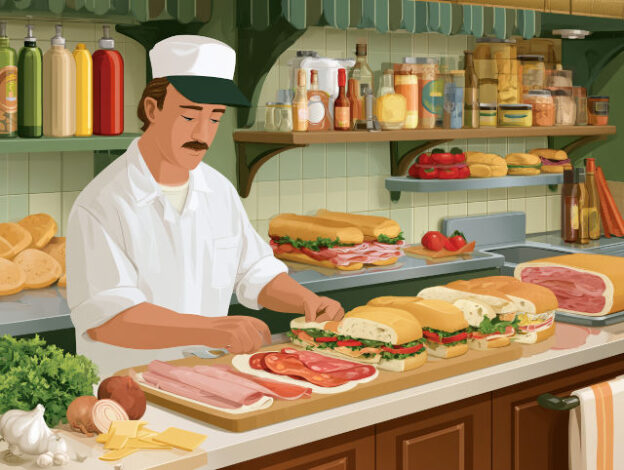
Consumers often assume that hand-prepared foods are fresher, more authentic, higher quality, and safer than factory-packaged alternatives. However, a new study suggests that these perceptions may create a food-safety blind spot. Researchers found that consumers tend to associate human involvement in food preparation with positive qualities that may not actually exist, a phenomenon they describe as the “handmade food halo.” The findings also show that carefully designed messaging can significantly influence purchasing decisions and encourage consumers to consider safer food options.
The study, led by Lavi Peng, Assistant Professor of Hospitality and Tourism Management at the University of Massachusetts Amherst, examined consumer attitudes toward deli meat. According to Peng, people often assume that hand-sliced products receive greater care and are therefore superior in quality. Yet from a food-safety perspective, greater human handling does not necessarily translate into a better product. In some cases, additional handling may increase opportunities for contamination and foodborne illness.
To explore these perceptions, researchers conducted two online experiments involving 344 U.S. consumers. Participants were asked to evaluate either hand-sliced deli meat prepared at a grocery store counter or factory-sliced, prepackaged deli meat. They rated the products based on appeal and purchase intention. Afterward, participants were presented with scientific information explaining that hand-sliced deli meat is associated with a substantially higher risk of listeriosis than prepackaged alternatives because increased human contact can elevate contamination risks.
The results confirmed the existence of the handmade food halo. Before receiving the food-safety information, participants consistently rated hand-sliced deli meat as more appealing and expressed stronger intentions to purchase it. Surprisingly, however, learning about the higher food-safety risks did not make consumers view the prepackaged option more favourably. Instead, the information merely reduced enthusiasm for the hand-sliced product. This finding suggests that correcting safety misconceptions alone may not be enough to shift consumer preferences toward safer alternatives.
In a second experiment, researchers modified the presentation of the prepackaged deli meat by incorporating cues associated with human care and authenticity. Packaging included images of farmers and messages emphasizing careful preparation and attention to quality. When participants were exposed to both the redesigned packaging and the food-safety information, their responses changed significantly. They rated the redesigned prepackaged product as more appealing and reported stronger purchase intentions than for either the standard packaged product or the hand-sliced deli meat.
The findings suggest that consumers are not necessarily seeking human contact itself, but rather the signals of care, trustworthiness, and authenticity that human involvement represents. For marketers and public health communicators, the study highlights the importance of making safety information visible at the point of purchase while also ensuring that safer products remain attractive and emotionally appealing. Although the research focused on deli meat because of its well-documented food-safety risks, the insights may also apply to other ready-to-eat foods, such as sushi and street foods, where consumers often equate handmade preparation with superior quality despite potential safety concerns.
More information: Heyao Yu et al, Human touch vs. food safety: How information interventions impact the handmade food halo, International Journal of Hospitality Management. DOI: 10.1016/j.ijhm.2026.104770
Journal information: International Journal of Hospitality Management Provided by University of Massachusetts Amherst