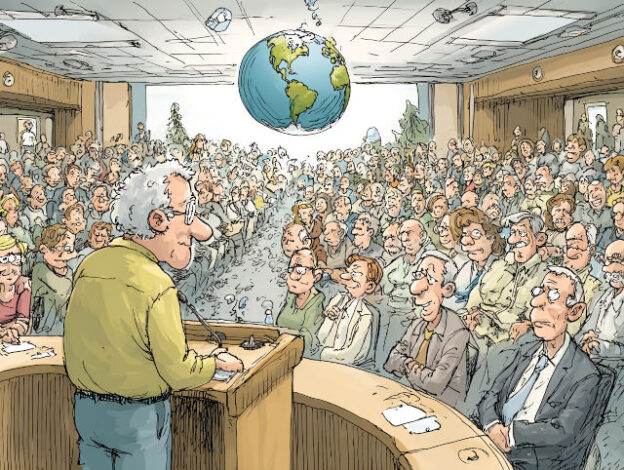
Governments around the world have pledged to meet ambitious climate targets, yet their current strategies are widely considered insufficient. A central reason for this shortfall is the continued pursuit of economic growth in wealthy nations. As production and consumption expand in these economies, overall resource use and energy demand increase, making it more difficult to reduce greenhouse gas emissions at the pace required to stabilise the climate. Despite decades of negotiations and policy initiatives, emissions reductions remain too slow to align with the goals of the Paris Agreement. The result is growing concern among scientists and policymakers that existing approaches may not be capable of preventing severe ecological damage and escalating risks to human societies. The persistence of growth-oriented economic models, critics argue, continues to place pressure on ecosystems and climate systems that are already under strain.
An emerging body of research proposes an alternative framework known as post-growth. Rather than assuming that well-being must be tied to ever-expanding economic output, post-growth approaches suggest that societies can achieve high levels of human welfare while stabilising or even reducing overall economic throughput. This perspective emphasises orienting production toward the direct satisfaction of human needs and distributing resources more fairly across populations. By prioritising essential goods and services such as healthcare, housing, and food security, proponents argue that societies could maintain strong social outcomes without relying on continual expansion of gross domestic product. Such an approach also enables faster emissions reductions by reducing unnecessary consumption and redirecting resources toward sustainable infrastructure and technologies.
A recent study conducted by researchers from the Institute of Environmental Science and Technology at the Universitat Autònoma de Barcelona (ICTA-UAB), the University of Lausanne, and the International Institute for Applied Systems Analysis has sought to clarify how these ideas could be incorporated into climate modelling. Published in Nature Climate Change, the research outlines principles for constructing scenarios that reflect a genuine post-growth transition. The authors note that existing degrowth or post-growth scenarios in climate research often fail to apply the concept consistently. In many cases, they merely depict economies with stagnant or declining GDP while leaving the underlying structures of production and distribution unchanged. As a result, many potential pathways toward a post-growth society remain insufficiently explored within mainstream climate mitigation models.
Lead author Aljoša Slameršak explains that post-growth does not simply mean producing less within the current economic system. Instead, it involves fundamentally transforming what societies produce and how those goods and services are shared. This would require reducing activities that generate social or ecological harm while expanding those that support human needs and environmental restoration. From this perspective, measuring well-being solely through indicators such as income or overall economic activity becomes inadequate. Slameršak emphasises that well-being should instead be assessed according to whether people’s basic needs are met, including secure housing, access to healthcare, adequate nutrition, and other essential services that support a dignified standard of living.
The researchers also highlight the importance of incorporating demand-side strategies and targeted technological investments into post-growth climate scenarios. Conventional climate models often represent innovation through assumptions about continued economic expansion, which may obscure the real impacts of policies aimed at restructuring consumption patterns. According to co-author Joel Millward-Hopkins, a post-growth transition would involve redistributing resources and reshaping economic systems to guarantee a decent standard of living for everyone while keeping non-essential consumption within ecological limits. This requires significant reductions in global inequality, along with a gradual convergence of resource use between countries in the Global North and Global South toward levels compatible with both human well-being and planetary boundaries.
Although many studies have examined individual aspects of post-growth thinking, comprehensive modelling tools capable of integrating multiple principles simultaneously remain limited. Researchers note that further work is needed to assess how social and environmental goals progress together while identifying possible tensions between them. Nonetheless, previous research suggests promising possibilities. Some analyses indicate that basic human needs worldwide could be met using less than half of the energy and materials currently consumed. At the same time, the authors acknowledge that a transition toward post-growth would face significant political, institutional, and economic obstacles. Established interests that benefit from the current growth-based system may resist such changes. Yet the researchers also argue that growth-oriented climate scenarios rely on their own uncertain assumptions, particularly the large-scale deployment of unproven negative emissions technologies. In contrast, post-growth approaches emphasise structural transformation that could, at least in principle, emerge through democratic debate and collective social action.
More information: Aljoša Slameršak et al, Principles for a post-growth scenario of ambitious mitigation and high human well-being, Nature Climate Change. DOI: 10.1038/s41558-026-02580-6
Journal information: Nature Climate Change Provided by Universitat Autonoma de Barcelona