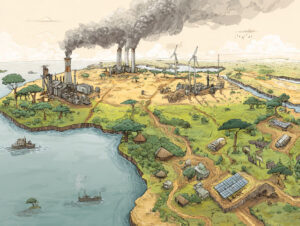
Climate change is an intensifying global concern that requires coordinated and sustained responses to reduce its far-reaching impacts. For Africa, where many countries are pursuing rapid economic development, the challenge is particularly complex. Progress in infrastructure, technology, and trade must be balanced against environmental sustainability. Understanding how these forces interact—especially the roles of digital expansion, energy choices, and economic growth—is essential for shaping effective policies. Recent research sheds light on this intersection by analysing how information and communication technologies (ICT), renewable energy consumption, trade imports, and economic development collectively influence carbon emissions across African nations. The goal is to inform pathways towards low-carbon growth that align with broader sustainable development priorities.
The study draws on a comprehensive dataset covering 29 African countries over the period from 2001 to 2020. Researchers from multiple universities applied a Panel Autoregressive Distributed Lag (PARDL) model to explore both short-term and long-term relationships among key variables. These included per capita carbon dioxide emissions, GDP per capita, renewable energy consumption, ICT indicators such as mobile subscriptions, and trade imports, all sourced from the World Development Indicators database. By accounting for country-specific variations and temporal dynamics, the analysis provides a robust framework for understanding how structural differences across nations shape environmental outcomes.
One of the most significant findings highlights the beneficial role of renewable energy in reducing emissions. The analysis shows that a 1% increase in renewable energy consumption is associated with a 0.14% reduction in per capita carbon dioxide emissions over the long term. Given that a considerable proportion of Africa’s population already relies on renewable energy sources, there is strong potential to expand these gains further. Scaling up access to clean energy—particularly in underserved and rural communities—could substantially lower emissions while also improving energy security and quality of life.
In contrast, the expansion of certain ICT components appears to contribute to rising emissions. The study finds that increased mobile cellular subscriptions are linked to higher carbon output, with a 1% increase associated with a 0.08% rise in emissions over time. Although digital technologies drive economic efficiency and connectivity, they also demand energy for device production, network infrastructure, and data processing. This creates a dual challenge: harnessing the developmental benefits of ICT while mitigating its environmental footprint. Promoting energy-efficient technologies and integrating renewable energy into digital infrastructure are critical steps in addressing this tension.
Trade dynamics present a more nuanced picture. Interestingly, the import of goods and services is associated with a reduction in emissions, with a 1% increase in imports corresponding to a 0.27% decline in per capita carbon dioxide emissions. This may reflect the displacement of more carbon-intensive domestic production or increased access to cleaner technologies from abroad. However, economic growth itself remains strongly linked to higher emissions, as increases in GDP per capita are associated with significant rises in carbon output. This underscores the central dilemma facing many African countries: how to pursue industrialisation and economic expansion without exacerbating environmental degradation.
Overall, the findings point to the need for carefully designed, integrated policy approaches. Expanding renewable energy offers a clear and effective route to emissions reduction, but it must be complemented by strategies that address the environmental costs of digitalisation and growth. Strengthening data collection systems across the continent is also essential, as gaps in reliable information limit the scope of analysis and policy planning. With more comprehensive data and coordinated action, African countries can better navigate the balance between development and sustainability, advancing towards a future that supports both economic progress and environmental resilience.
More information: Robert Ugochukwu Onyeneke et al, Impact of Information and Communication Technologies and Renewable Energy Consumption on Carbon Emissions in Africa, Carbon Research. DOI: 10.1007/s44246-024-00130-3
Journal information: Carbon Research Provided by Biochar Editorial Office, Shenyang Agricultural University