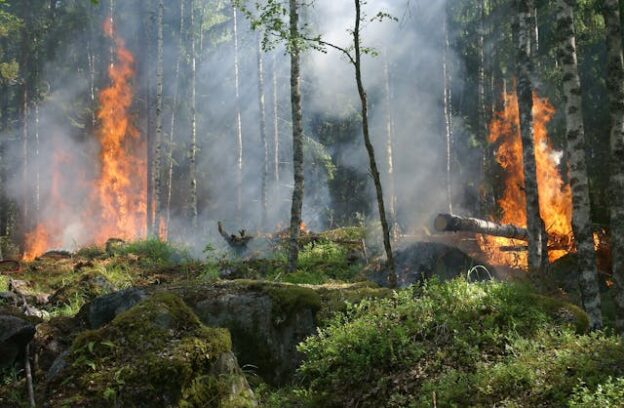
Climate-related wildfires have returned to the spotlight this summer, dominating headlines as they blaze across vast areas of the northern hemisphere. With each passing year, these fires are growing more intense and more destructive, driven by rising global temperatures and prolonged periods of drought. Yet a new study by researchers at the International Institute for Applied Systems Analysis (IIASA) reveals that the true economic toll of wildfires is not determined by climate alone. Instead, the vulnerability of a country’s social and economic systems plays a decisive role in shaping how severely wildfires impact its economy. This research reinforces the message that sustainable development must be central to efforts aimed at reducing climate-related losses.
Wildfires are no longer isolated environmental emergencies; they have evolved into persistent, global threats that leave devastation in their wake. Their effects span continents—from affluent regions with sophisticated emergency services to poorer countries with limited firefighting infrastructure. However, the capacity to recover from such disasters is far from equal. In low-income nations, where economic safety nets and public institutions are often weaker, the repercussions of wildfires can reverberate for years, deepening poverty and eroding development gains. As climate change accelerates, fire seasons are becoming longer and more severe, with damages expected to grow exponentially, straining national budgets, displacing communities, and widening existing inequalities.
The IIASA study, led by researcher Yi‑Ling Hwong from the institute’s Energy, Climate, and Environment Programme, examined wildfire impacts across 165 countries. By analysing a wide range of climate projections and development trajectories, the team set out to understand why some countries suffer far more economic damage than others during wildfire events. Their goal was to uncover the drivers behind this disparity and assess how future damages might unfold depending on global policy choices. “We wanted to go beyond just climate conditions and examine how socioeconomic structures contribute to wildfire outcomes,” explains Hwong. “This perspective is essential if we are to design adaptation strategies that work globally.”
The results were striking. By 2070, under a high-emissions scenario, economic losses from wildfires could be up to three times higher than under a development pathway aligned with sustainability. While rising temperatures and increased fire frequency are significant factors, the research highlights that social and economic vulnerability are equally influential in shaping the magnitude of damages. This effect is especially pronounced in the Global South, where avoided losses in a sustainable development scenario could exceed 2% of GDP, more than ten times the relative gains projected for high-income countries. These findings point to a fundamental truth: the burden of climate-related disasters is not evenly shared, and socioeconomic resilience is a critical determinant of impact.
Co-author Edward Byers, also of the IIASA Energy, Climate, and Environment Programme, reflects on the implications: “Traditionally, wildfire research has focused on burned area and weather conditions, and climate has rightly been seen as the main driver of fire risk. But our findings challenge the assumption that climate alone dictates economic outcomes. We now see that development choices—like strengthening infrastructure, building social safety nets, and promoting equity—can significantly reduce the costs of wildfires, even as fire risks rise. That should give policymakers hope and a clear direction forward.”
The message is unambiguous: effective adaptation to wildfires cannot rely solely on fire suppression or emissions control. Instead, it demands a broader, more integrated approach that encompasses climate action and long-term development planning. Strengthening governance, investing in inclusive infrastructure, and reducing social disparities are all essential components of a resilient society. If emissions continue unchecked and sustainable development is neglected, the compounding pressures of climate change will soon surpass the capacity of even the wealthiest nations to respond effectively.
In conclusion, the authors of the study urge governments to adopt a dual approach—one that combines immediate climate mitigation efforts with transformative social investment. “Wildfires are becoming more frequent, more intense, and more economically disruptive,” says Hwong. “But we are not powerless in the face of this threat. By focusing on equitable development and building stronger societies, we can not only reduce the costs of wildfires but also enhance our resilience to a wide range of climate impacts. Ultimately, this is about creating a safer, more sustainable future for all.”
More information: Yi‑Ling Hwong et al, Sustainable development key to limiting climate change-driven wildfire damages, Environmental Research Climate. DOI: 10.1088/2752-5295/adec11
Journal information: Environmental Research Climate Provided by International Institute for Applied Systems Analysis