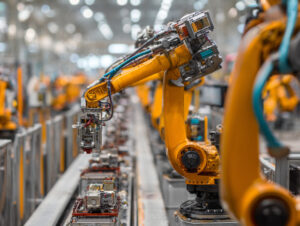
Autonomous robotics is widely seen as a force that could fundamentally reshape the future of manufacturing. The promise lies in systems that are not only faster but also more adaptable and customisable than today’s traditional assembly lines. However, the vision of factories populated by fleets of mobile, intelligent robots brings with it a formidable challenge: how to coordinate the movements of large numbers of machines in the same space, while also ensuring they can collaborate smoothly both with one another and with human workers. This challenge sits at the heart of cutting-edge robotics research.
At Stanford University, a team of researchers has developed an algorithm designed to tackle precisely this problem. The system is capable of analysing a product’s design plan and generating the most efficient way to manufacture it using a team of robots. Their findings, recently published in the journal Robotics and Autonomous Systems, demonstrate the algorithm’s ability to plan subassemblies, such as building a car door before attaching it to the main body, and to orchestrate how robots work either independently or in groups. It even determines the most effective factory layout to prevent accidents and avoid bottlenecks.
Mac Schwager, an associate professor of aeronautics and astronautics at Stanford and co-author of the study, described the innovation as unusually broad in scope. “There has been research into some of these individual pieces,” he explained, “but I think we’re the first to really think about how it all fits together into a large-scale system.” In essence, the work shifts the focus away from solving isolated problems and towards integrating multiple challenges into a cohesive, large-scale solution that mirrors the realities of industrial production.
One of the most compelling aspects of this research is its potential to enable modular manufacturing. Current automated assembly lines excel at producing a single item with high efficiency, but they are rigid and difficult to reconfigure. By contrast, a system built on general-purpose robots distributed across flexible workstations could allow factories to adapt far more easily. Whether pivoting to a new product line or offering customised goods, such factories would not need to dismantle and rebuild their entire production infrastructure to accommodate change.
This point was emphasised by Dylan Asmar, a PhD student in Stanford’s Intelligent Systems Laboratory and co-author of the study. “Right now, if you want to change your construction pipeline to something different, it requires a lot of planning and work to tear it down and set it back up,” he noted. “With a more modular approach like this, changing your pipeline would be a lot easier and more streamlined.” The vision here is of a system in which flexibility is not an afterthought but a defining feature, enabling rapid responses to market demands.
The Stanford algorithm achieves this by blending detailed information about both the robots and the product to be built. Researchers input specifications such as the number of robots, their carrying capacity, and the schematic of the desired product. The system then determines how to divide tasks into subassemblies, coordinate multiple robots for larger components, and arrange simultaneous operations to save time. “Our objective is to go from raw material to the finished product as quickly as possible, and the way you do that is through parallelisation,” said Mykel Kochenderfer, a senior author of the study. “It’s not a linear sequence – we try to do operations in parallel as frequently as possible.”
To illustrate its capabilities, the researchers tested the algorithm on a toy model of a Saturn V rocket, consisting of 1,845 parts organised into 306 subassemblies. The system, working with a virtual team of 250 robots, generated a complete assembly plan in under three minutes. This included not only the order of operations but also the layout of assembly stations, the assignment of transport tasks, and the routing of robots to avoid interference with one another. The speed and thoroughness of this planning illustrate the algorithm’s potential for tackling real-world industrial complexity.
While the approach is promising, the researchers are cautious in noting that significant challenges remain before such systems can be applied in commercial manufacturing. To support further development, Kyle Brown, the paper’s lead author, created an open-source simulator that allows researchers to test and refine algorithms. The platform can be used both as a research tool and an educational one, as Brown demonstrated by running a classroom activity where children raced against robots in constructing a model aeroplane. “The kids were elated at their narrow victory,” Brown said, “and I got to teach them a little bit about robots.” It may be some time before factories adopt such systems, but the work signals a significant step toward the next revolution in manufacturing.
More information: Kyle Brown et al, Large-scale multi-robot assembly planning for autonomous manufacturing, Robotics and Autonomous Systems. DOI: 10.1016/j.robot.2025.105179
Journal information: Robotics and Autonomous Systems Provided by Stanford University