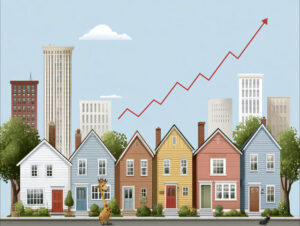
A new study from the University of Cincinnati has shed unexpected light on the complex relationship between police spending and housing prices—one that had eluded researchers for decades. At first glance, the findings aligned with prior studies, showing little to no relationship between law enforcement budgets and home values or sales volumes. However, a stark contrast emerged when economics professor David Brasington, PhD, disaggregated the data by income levels. The effect of police funding on property prices was not uniform across neighbourhoods but instead showed prominent, opposing trends depending on whether the community was wealthy or low-income.
Published in the Journal of Real Estate Finance and Economics, Brasington’s study, titled “The Effect of Increased Police Spending on House Prices and Sales Volume: A Tale of Two Types of Cities,” offers a fresh and nuanced view. In low-income communities, an increase in the police budget led to a roughly 13% rise in housing prices. In contrast, high-income areas experienced a minimum 14% decline in house prices following the same budgetary increase. These opposing shifts had long gone unnoticed because past studies only examined the average effect, effectively masking the divergent patterns.
According to Brasington, the issue’s core lies in how data was previously aggregated. “The small or nonexistent link between house prices and crime found by the literature really just reflects the sum of large but opposite moves in house prices in different market segments,” he wrote. It was only by splitting the sample into high- and low-income groups that the true nature of the effect became visible. Without this distinction, the opposing movements cancelled each other, creating the false impression that police funding had little impact on housing markets.
Brasington’s analysis focused on Ohio, drawing from decades of local referendums on police funding increases—typically through tax levies averaging a 15% rise in the budget. He then compared those events to housing data from 1995 to 2018. Initially, he aimed to study how police tax renewals influenced sales volumes and pricing. While there appeared to be minimal overall change in the number of transactions, the split data revealed a compelling pattern in property valuations that persisted for at least five years after the votes. The number of homes sold remained unchanged, but perceptions of value—reflected in prices—shifted substantially.
The results suggest that residents in low-income communities prioritise increased police presence, likely associating it with greater security, reduced crime, and improved neighbourhood conditions. These factors make such areas more attractive to buyers, raising demand and prices. In this context, additional police funding functions as a positive amenity, much like better schools or improved public transport might. Brasington interpreted this as evidence that increased police spending in disadvantaged areas is politically popular and economically beneficial to homeowners and residents.
Conversely, the decline in property values within high-income neighbourhoods indicates a different perception. Brasington suggests that residents may feel that law enforcement is already adequately funded or overfunded in these areas. Further budget increases—particularly through tax hikes—represent a net negative. “If you cut police taxes and services, the high-end views that as a good thing,” he said. From this perspective, reducing police levies could increase housing demand due to lower property taxes while constraining supply, thus pushing higher prices. The study challenges simplistic assumptions that policing is uniformly valued across socioeconomic strata.
Brasington advocates for a more refined approach to public policy and housing economics in light of these findings. He argues that this kind of income-based differentiation should be more commonly used in evaluating the consequences of government spending. Furthermore, he notes that other public levies—such as those for education, infrastructure, or healthcare—may produce similarly polarised effects across income brackets. Future research, he suggests, should also explore how these dynamics play out in middle-income communities, which remain an unexamined segment in this study. By highlighting the hidden complexity behind aggregate figures, Brasington’s work calls for more sophisticated policymaking that accounts for local context and varying community needs.
More information: David Brasington, The Effect of Increased Police Spending on House Prices and Sales Volume: A Tale of Two Types of Cities, The Journal of Real Estate Finance and Economics. DOI: 10.1007/s11146-025-10012-z
Journal information: The Journal of Real Estate Finance and Economics Provided by University of Cincinnati