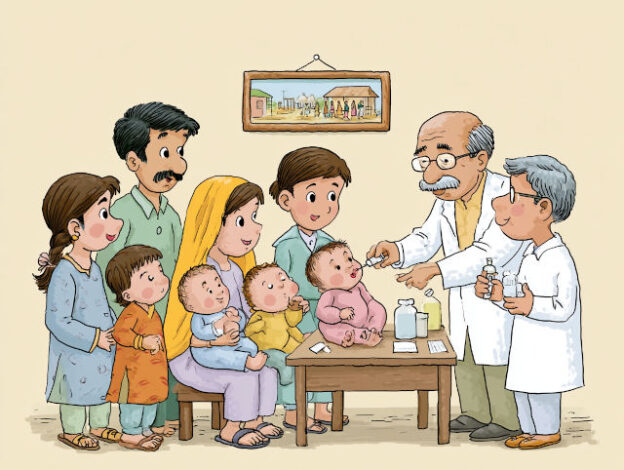
Each year, around 700,000 children die from vaccine-preventable diseases, with nearly all of these deaths occurring in low- and middle-income countries. New research by University of Notre Dame economist Santosh Kumar Gautam shows that India’s Universal Immunization Programme (UIP) substantially reduced child mortality, while also producing more complex long-term effects on educational attainment. Published in the Journal of Population Economics, the study highlights the need to coordinate health and education policies so that improvements in child survival are matched by investments that support children’s learning and long-term development.
India introduced the UIP in 1985, expanding it district by district before achieving nationwide coverage by 1990. This staggered rollout created a natural experiment, allowing Gautam to compare children born just before and just after the programme reached their district, while taking advantage of the fact that only children under one year of age were eligible for vaccination. Analysing data from a national survey of nearly 900,000 children, the study found that the programme reduced infant mortality by 0.4 percentage points and under-five mortality by 0.5 percentage points—significant improvements at a time when almost one in ten infants died before their first birthday.
The mortality benefits were concentrated among children from rural areas, poorer households and historically disadvantaged caste groups. By contrast, children from wealthier, urban and higher-caste families experienced little change, likely because many already had access to vaccination before the programme was introduced. According to Gautam, these findings demonstrate that large-scale public immunisation campaigns can effectively reach vulnerable populations despite longstanding concerns about weaknesses in healthcare delivery and implementation in developing countries.
The research also found that the programme had mixed effects on education. While exposure to the UIP reduced primary school completion, it increased secondary school completion among surviving children. Gautam suggests these contrasting outcomes reflect changes in the composition of the student population. Vaccination enabled some children with poorer underlying health, who otherwise might not have survived to school age, to enter primary school, lowering average completion rates. At the same time, children who would likely have survived regardless but enjoyed better health because of immunisation were more likely to remain in school and complete secondary education. Limited school capacity and overcrowded classrooms may also have contributed to lower completion rates in the early grades.
“These findings show that vaccines are among the most cost-effective investments countries can make to improve child health and human capital,” Gautam said. “I wanted to understand not only how India’s immunisation program saved lives, but also how it affected educational trajectories and human capital development.” He added that improvements in child survival should be accompanied by policies that ensure schools have the capacity to support growing numbers of students throughout their education.
The study concludes that health and education policies should be designed together rather than pursued independently. Governments that invest in childhood immunisation should also strengthen educational systems so that gains in survival translate into stronger human capital outcomes. Gautam’s research contributes to a broader understanding of how early-life health investments reduce poverty and improve long-term wellbeing, particularly in resource-constrained settings where effective policy coordination is essential to achieving the greatest social and economic returns.
More information: Santosh Kumar Gautam, The effects of childhood immunization programs on health and education: micro-evidence from India, Journal of Population Economics. DOI: 10.1007/s00148-026-01186-8
Journal information: Journal of Population Economics Provided by University of Notre Dame