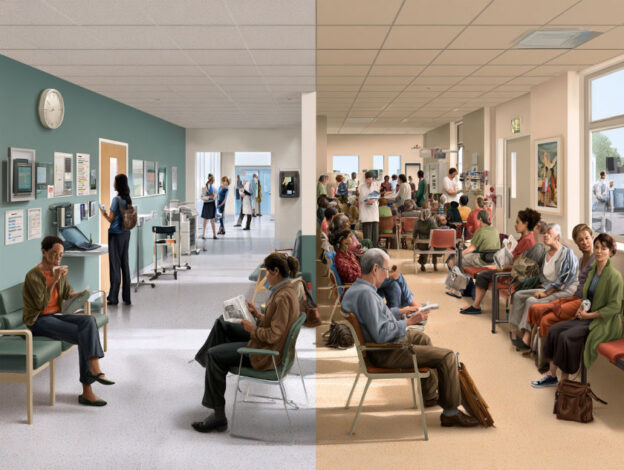
A country’s economic standing may reveal more about its access to essential healthcare than its location on the world map. New research suggests that wealthier nations generally provide better health coverage, while countries with higher levels of human development tend to have stronger healthcare systems. The findings highlight persistent inequalities in access to medical services and the importance of economic and social development in improving global health.
Published in the open-access journal PLOS Global Public Health, the study was conducted by Akira Hayasaka of Yokohama City University, Yasuhiro Nakanishi of Japan’s National Institute of Public Health, and their colleagues. The researchers examined how healthcare coverage relates to human development, national income and geographic location, offering new insights into the factors shaping healthcare access worldwide.
Universal health coverage (UHC) is a major objective of the United Nations Sustainable Development Goals. Progress is measured through the UHC Service Coverage Index, which evaluates four areas: reproductive, maternal, newborn and child health; infectious diseases; noncommunicable diseases; and healthcare service capacity and access. The index provides a broad picture of how effectively countries deliver essential health services to their populations.
Although better healthcare and human development have long been closely connected, researchers wanted to understand how that relationship differs across income groups, geographic regions and healthcare categories. Using publicly available data from the World Health Organization and United Nations, they analysed national trends across seven selected years between 2000 and 2021, comparing healthcare coverage with the Human Development Index (HDI).
The results revealed substantial economic inequalities. After accounting for other factors, low-income countries scored 21% lower in overall healthcare coverage than high-income countries. The divide was particularly pronounced for infectious diseases, where coverage was 31% lower. In general, differences between income groups exceeded those between World Health Organization regions, suggesting that economic circumstances may matter more than geography.
Human development also showed a strong connection with healthcare performance. Every 0.1-point increase in HDI was associated with a 6.8-point improvement in overall coverage. The relationship was strongest for healthcare capacity and access, which increased by 11.7 points, and weakest for noncommunicable diseases, at 2.2 points. These differences suggest that improvements in national development do not benefit every healthcare sector equally.
The researchers cautioned that their findings reflect national averages rather than individual experiences, meaning inequalities within countries may remain hidden. Changes in the indicators used to calculate healthcare coverage over time also complicate comparisons between reporting periods. Furthermore, the associations identified do not establish that higher human development directly causes better healthcare coverage.
Nevertheless, the findings offer an important message for policymakers: improving healthcare access may require progress well beyond hospitals and medical services. Broader investments in economic and social development could help countries strengthen their healthcare systems and narrow persistent coverage gaps. As the authors emphasised, development outside the healthcare sector is closely associated with access to essential services, providing valuable guidance for efforts to build a healthier, more equitable world.
More information: Akira Hayasaka et al, Associations between the universal health coverage service coverage index and the human development index: A country-level longitudinal panel study, PLOS Global Public Health. DOI: 10.1371/journal.pgph.0007328
Journal information: PLOS Global Public Health Provided by PLOS