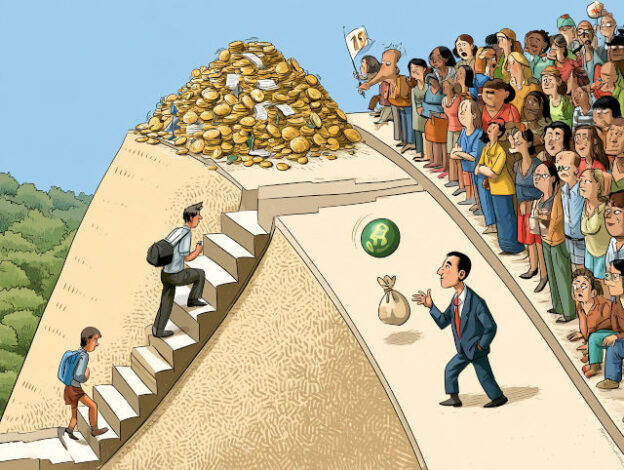
Imagine two people ending up equally wealthy—but one built their fortune through years of hard work, while the other won the lottery. Would you view their wealth in the same way? And if society wanted to redistribute some of that money, would it matter how each person became wealthy in the first place? New research suggests that for many people, the answer is yes—but attitudes towards luck, merit and economic inequality vary considerably around the world.
Economist Ingvild Almås of the University of Zurich is investigating why people are willing to accept inequality and when they support redistribution, such as higher taxes on the wealthy. “Inequality is an important global issue. A key question is how inequality is morally justified in the society,” says Almås. Her recently published study, conducted with Norwegian colleagues, reveals substantial differences between countries.
The study surveyed 65,000 people across 60 countries, representing about 80 percent of the world’s population. Participants were presented with scenarios involving real workers on an online labour market platform and asked how bonuses should be distributed—for example, according to performance or through a random lottery. Researchers also examined participants’ attitudes towards redistributing wealth through taxation and other policy measures.
Overall, people were more willing to accept inequality when financial rewards resulted from work rather than chance. This merit-based view of fairness was especially strong in countries such as Switzerland. “We see a merit-based understanding of fairness primarily in countries with democratic political systems that are richer, more equal, and more individualistic,” says Almås. Even so, Swiss participants showed some support for redistribution when inequality resulted from luck.
Attitudes differed considerably elsewhere. Researchers found greater acceptance of wealth gained through luck in non-Western countries, including China and India. Many participants in these countries also opposed redistributing wealth acquired by chance. Almås suggests that cultural and other factors may help explain these differences. Future research will examine whether attitudes towards redistribution are associated with different religious beliefs.
The researchers also considered whether people tolerate inequality because redistribution may carry economic costs. For instance, some may believe that higher taxes discourage high earners from working as much, potentially reducing economic activity. However, the study found that such concerns played a much smaller role globally than perceptions about how inequality arose in the first place—particularly whether it resulted from luck or merit.
The findings also highlight the importance of studying human behaviour beyond so-called WEIRD societies—Western, educated, industrialised, rich and democratic countries—which have traditionally been heavily represented in social science research. “The findings have revealed a significant contrast between Western and non-Western societies,” says Almås, suggesting that ideas about fairness cannot necessarily be generalised across cultures.
By examining attitudes across such a broad range of countries, the study offers a more global picture of how people morally justify inequality. The findings suggest that acceptance of unequal outcomes depends not simply on how large the gap is, but also on why that gap exists. Understanding these differences may help explain why societies vary in their support for taxation, redistribution and other policies aimed at reducing economic inequality.
More information: Ingvild Almås et al, Fairness Across the World, The Quarterly Journal of Economics. DOI: 10.1093/qje/qjag044
Journal information: The Quarterly Journal of Economics Provided by University of Zurich