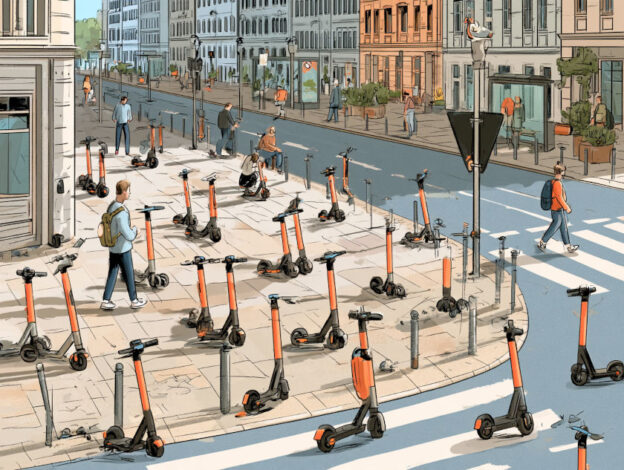
Electric scooters promised to transform urban transport, offering a convenient and affordable way to travel short distances. But as competing operators rushed to establish themselves in American cities, pavements became crowded with vehicles that often sat unused. New research suggests the problem was not simply poor planning, but a predictable consequence of fierce competition for customers.
A study from the McCombs School of Business at the University of Texas at Austin found that scooter companies deliberately deployed far more vehicles than riders needed. The strategy helped operators capture market share, even as thousands of scooters remained idle and city authorities struggled to manage the growing clutter.
The researchers examined scooter deployment and ridership data from nine US cities, alongside detailed information from Kansas City, Missouri. Their analysis focused on the industry’s rapid expansion between 2018 and 2021, when companies such as Lime and Bird competed aggressively to dominate the emerging micromobility market.
The scale of oversupply was striking. While local policymakers targeted an average daily utilisation rate of 7.7%, actual utilisation across the nine cities was just 3.6%. That meant approximately 96% of scooters went unused on an average day, raising questions about whether unrestricted competition was serving the public interest.
According to the researchers, venture capital funding encouraged companies to prioritise growth over profitability. Operators wanted to demonstrate their dominance by placing as many scooters as possible in convenient locations. “Profitability was not the aim,” said associate professor Ioannis Stamatopoulos. “It was showing they were the biggest player.”
Consumer behaviour reinforced the strategy. Riders frequently had several scooter-sharing apps installed and tended to choose whichever vehicle was closest, regardless of brand. At an intersection with nine Lime scooters and one Bird scooter, for example, Lime would have roughly a 90% chance of attracting the next customer.
This created a competitive cycle in which every operator had an incentive to add more scooters, even when existing fleets exceeded demand. In Kansas City, researchers calculated that competition had expanded an economically optimal fleet of 188 scooters to 1,188, representing a 531% oversupply. Introducing another competitor could have increased that figure to 613%.
The findings suggest that allowing more operators into a city does not necessarily improve services. Instead, the researchers recommend limiting permits to two companies, arguing that this would preserve meaningful competition while reducing unnecessary vehicles on public streets.
Municipal authorities could also establish minimum utilisation requirements, monitor ridership and penalise companies whose scooters consistently remain unused. Such measures would encourage operators to reduce their fleets without worrying that competitors would immediately fill the available space.
The industry has already undergone considerable consolidation through mergers and bankruptcies, leaving fewer operators and improving utilisation rates in some markets. Nevertheless, the research offers a broader warning for cities embracing shared transport services: more competition does not always produce better outcomes. As Stamatopoulos observed, the ideal is to maintain some competition, but not too much.
More information: Hale Erkan et al, Competition for Customer Attention is Creating Oversupply Pockets in US Micromobility, Operations Research. DOI: 10.1287/opre.2023.0305
Journal information: Operations Research Provided by University of Texas at Austin