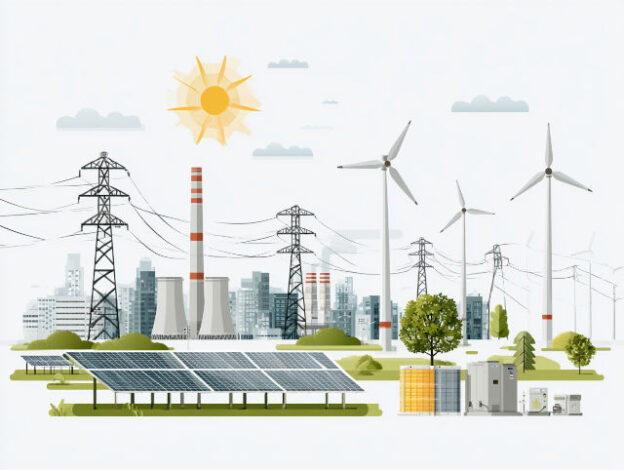
China’s rapid expansion of renewable energy is transforming its electricity system and raising an important question: can the country maintain grid reliability while phasing out coal? Wind and solar power are inherently variable, and as their share of electricity generation grows, conventional coal plants are expected to operate fewer hours while the power system requires greater flexibility. According to a study published in Energy and Climate Management on 25 May 2026, variable renewable energy accounted for 18.2% of China’s electricity generation in 2024. It could reach 65–70% by 2060, making flexibility increasingly critical to maintaining a stable electricity supply.
Researchers led by Tsinghua University explored this challenge using causal loop diagrams to analyse the interactions among renewable deployment, energy storage, electricity markets, capacity payments, and coal retirement. Their analysis suggests that while China’s current coal capacity payment mechanism can help stabilise revenues for coal plants during the energy transition, it may also create unintended consequences. Because payments primarily support existing coal and gas generators, emerging flexible resources—including battery storage, demand-side response, distributed energy resources, and virtual power plants—may receive limited support. The study also notes that administratively determined payments risk overcompensating generators, discouraging innovation, and delaying the retirement of inefficient coal plants.
The paper compares China’s approach with the United Kingdom’s capacity market, where competitive auctions procure reliable capacity from multiple technologies. This market-based system helps reveal the value of reliability while encouraging broader participation from different resources. However, the authors caution that capacity market design remains important. If all technologies are rewarded equally without accounting for storage duration, short-duration batteries may be favoured even though longer-duration resources are better suited to maintaining reliability during prolonged periods of system stress.
Energy storage is identified as a key source of system flexibility. Battery energy storage systems can absorb excess renewable electricity and discharge it when demand increases, reducing renewable curtailment and improving grid stability. However, China’s earlier storage mandates produced mixed results. Although they accelerated deployment, the average utilisation rate of mandated storage projects was only 9% in 2023. The study attributes this largely to limited market access and insufficient revenue opportunities, noting that thermal generators received 91.4% of ancillary service market revenues during the first half of 2023.
To better integrate storage, the authors recommend deepening electricity market reforms by expanding spot markets, easing restrictive price caps, and creating more competitive ancillary service markets. These changes would allow storage operators to earn revenue through energy arbitrage, frequency regulation, capacity mechanisms, and other grid services. Rather than requiring individual renewable projects to pair with dedicated storage, the study argues that flexibility should be treated as a shared, system-wide resource that can be deployed where it delivers the greatest benefit.
Looking further ahead, the study identifies long-duration energy storage as an essential component of a fully decarbonised power system, estimating that China could require more than 700 GW of such capacity by 2060. It also proposes strategic reserves as a transitional measure, allowing selected retired coal plants to remain available for emergency use outside the regular electricity market. Overall, the authors recommend piloting competitive capacity markets, expanding revenue streams for storage, supporting long-duration storage technologies, strengthening carbon pricing through an emissions cap and price floor, and using strategic reserves where necessary to maintain grid reliability while accelerating the transition away from coal.
More information: Ying Zhou et al, Maintaining security of power supply in the context of technological change driven by low-carbon transition, Energy and Climate Management. DOI: 10.26599/ECM.2026.9400033
Journal information: Energy and Climate Management Provided by Tsinghua University Press