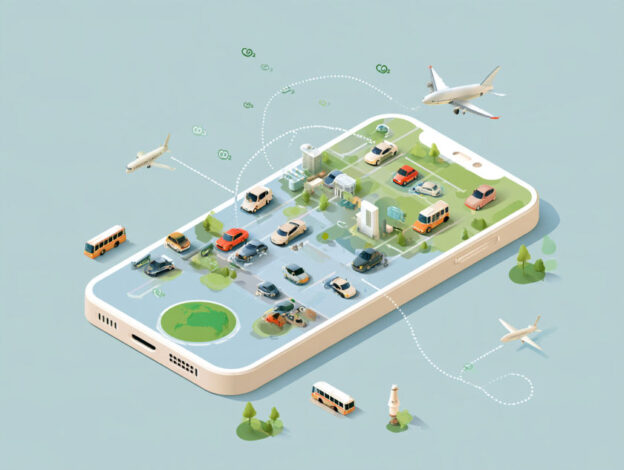
What if the movements of millions of mobile phone users could help scientists measure carbon emissions almost as they happen? Researchers have developed a promising new approach that uses smartphone mobility data to track changes in carbon pollution, potentially giving governments a faster and clearer picture of how everyday activities affect the environment.
Published in The Innovation, the study brings together scientists from the National University of Defense Technology, the University of Hong Kong and research institutions across three continents. Their work explores a simple idea: when people travel, goods are transported, and businesses operate, these activities often generate carbon emissions. By studying patterns of movement, researchers may be able to estimate how much pollution is being produced.
Traditional methods of measuring carbon emissions rely heavily on government statistics, energy records and industrial reports. Although generally reliable, these figures can take months to compile. Satellites offer another way to monitor emissions, but their measurements have limitations. Scientists therefore wanted to develop a faster system capable of detecting changes in human activity as they happen.
The COVID-19 pandemic provided an unusual opportunity to test the idea. In early 2020, lockdowns brought travel and economic activity to a sudden halt across many Chinese cities. Researchers analysed anonymised mobile phone records from approximately 318 million China Unicom users, tracking daily travel patterns between cities during January and February.
Using artificial intelligence, the team examined how cities were connected through travel and compared those movements with existing carbon emission estimates. The results revealed a strong relationship between changes in mobility and pollution. When travel declined during lockdowns, emissions generally fell too. The computer models were particularly successful at estimating emissions associated with aviation and ground transportation.
The researchers then tested whether their approach could work beyond China. Applying similar methods to Italy, the United States and Mexico, they found that mobile phone mobility patterns could also provide highly accurate estimates of carbon emissions. This suggested that the technique might eventually support emissions monitoring across different countries and regions.
The findings also revealed something unexpected. By examining how people travelled between cities, researchers identified groups of economically connected urban areas that did not necessarily follow administrative boundaries. These connections could help governments understand how emissions are shared across regions and encourage neighbouring cities to coordinate their climate policies more effectively.
Despite the encouraging results, the researchers acknowledge that smartphone data cannot capture every source of pollution. The Chinese study covered only two months and focused on travel between cities rather than movement within them. Future improvements could combine mobility information with satellite observations, weather conditions and energy consumption data. Nevertheless, the research points towards a future in which carbon emissions can be monitored much more quickly, helping policymakers respond to environmental changes while they are happening rather than months afterwards.
More information: Mengning Wang et al, Inferring carbon emissions from human mobility data, The Innovation. DOI: 10.1016/j.xinn.2026.101501
Journal information: The Innovation Provided by Innovation Press