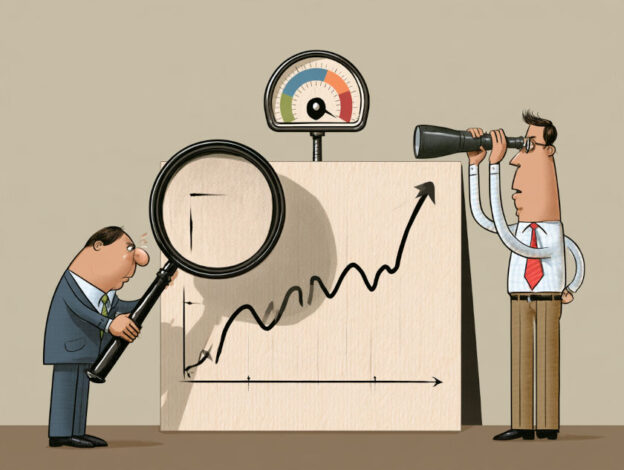
When people receive new information, they often adjust what they believe. But those adjustments are not always proportional to the evidence. Sometimes people change their beliefs too little, while at other times they react too strongly. A new study examines why people may underreact or overreact to information depending on the type of judgement they are making.
The study, published in Econometrica, was conducted by researchers at Carnegie Mellon University, Lehigh University, and the London School of Economics and Political Science (LSE). The researchers compared how people responded to the same information when asked either to draw conclusions about a current situation or to predict a future outcome.
Economists have long used the concepts of underreaction and overreaction to help explain patterns in areas such as finance and macroeconomics. However, researchers have not reached a clear consensus on why people appear to underreact to information in some situations but overreact in others.
To investigate, the researchers examined two common types of belief updating. The first was an “inference” problem, in which people received information and used it to judge an underlying situation or condition. The second was a “forecast-revision” problem, in which people received the same information but used it to revise their expectations about what would happen in the future.
The researchers discovered a striking difference. Participants tended to underreact to new information when trying to determine an underlying situation, meaning they did not adjust their beliefs as much as the evidence suggested they should. However, when using the same information to predict a future outcome, participants tended to overreact, changing their forecasts more than the evidence warranted.
The researchers call this difference the “inference-forecast gap.” Their findings suggest that the gap occurs largely because people use different mental shortcuts, or rules of thumb, for the two types of tasks. In other words, people may process the same information differently depending on whether they are trying to understand what is happening or predict what will happen next.
“Our findings suggest that this discrepancy may arise because people consider some problems inference tasks and others forecast-revision tasks, leading them to approach the two in fundamentally different ways,” explains Tony Q. Fan, Assistant Professor of Economics at Lehigh University’s College of Business, who led the study. Understanding how people mentally frame a problem may therefore be important for explaining why they sometimes respond inaccurately to new information.
The findings add to a growing body of research on how people revise their beliefs. According to the researchers, whether people underreact or overreact may depend not only on the information they receive, but also on the question they are trying to answer. The study highlights how complexity, mental shortcuts and inaccurate mental models can influence the way people interpret evidence, form judgements and make predictions.
More information: Tony Q. Fan et al, The Inference-Forecast Gap in Belief Updating, Econometrica. DOI: 10.3982/ECTA23334
Journal information: Econometrica Provided by Carnegie Mellon University