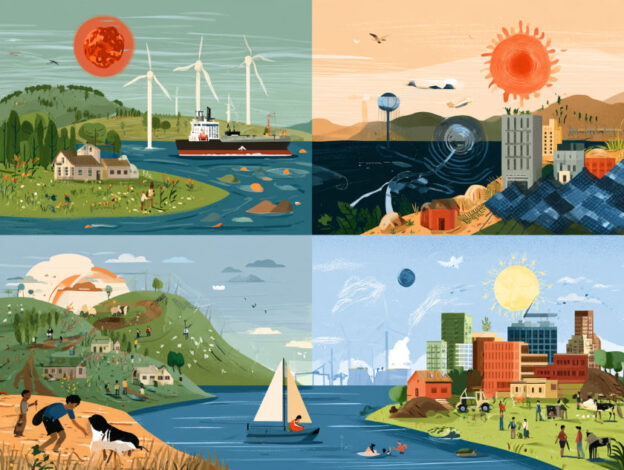
The future of global health will depend on more than rising temperatures and changing weather patterns. Economic development, healthcare access, technological advances and government policies will also shape how societies respond to climate change. To better understand these interconnected challenges, an international team of researchers has expanded existing climate scenarios to explore how public health could evolve throughout the 21st century.
The research builds on the Shared Socioeconomic Pathways (SSPs), five scenarios developed by climate scientists about a decade ago. These pathways describe possible futures based on different patterns of economic growth, population change, environmental policies and international cooperation. Scientists and policymakers use them to assess how today’s decisions could influence climate change and its consequences through 2100.
Each pathway presents distinct opportunities and challenges. The “Sustainability” scenario envisions greater environmental protection, reduced inequality and investment in clean energy. In contrast, “Regional Rivalry” describes a fragmented world marked by nationalism, competition for resources and slower economic development. Another scenario, “Fossil-Fueled Development”, anticipates rapid economic growth alongside increasing greenhouse gas emissions.
However, economic prosperity does not necessarily guarantee better health. Although fossil-fuel-driven growth could support improvements in education and healthcare, worsening pollution and extreme heat could create additional health risks. Existing climate models often overlook important questions about hospital capacity, healthcare accessibility, mental health and the ability of communities to adapt to environmental changes.
To address these gaps, 63 international experts in climate change and public health gathered in Vienna to develop more detailed health-focused scenarios. Their findings, published on 5 October in The Lancet Planetary Health, offer a broader understanding of how healthcare systems, population health and social conditions might change under different socioeconomic futures.
Carole Green, a doctoral student in environmental and occupational health sciences at the University of Washington, participated in the workshop and served as lead author of the accompanying paper. According to Green, conventional climate projections frequently emphasise temperature increases and population trends without adequately considering how social conditions, healthcare infrastructure and public policies might evolve alongside climate change.
The expanded scenarios reveal that future health outcomes are neither inevitable nor straightforward. Technological progress and economic growth may improve healthcare while simultaneously contributing to environmental deterioration. Similarly, investments in climate adaptation may reduce certain risks without eliminating others. Factors such as government effectiveness, health-system capacity, social equity and access to essential resources could significantly influence population well-being.
Researchers hope these more comprehensive scenarios will help governments anticipate emerging health threats and develop effective policies. Their work considers issues such as food insecurity, access to clean water, air quality, healthcare availability and climate-related disease burdens. Understanding how these factors interact could help communities strengthen their resilience and prepare for increasingly complex public health challenges.
The next phase will examine how the scenarios apply to Brazil, Senegal, South Africa, India, Vietnam and the Solomon Islands, incorporating local knowledge and regional circumstances. Researchers also plan to estimate future disease burdens and assess healthcare access, sanitation infrastructure and digital health development. Ultimately, the project highlights an important message: the future of global health is not predetermined, and decisions made today could profoundly influence the health and well-being of generations to come.
More information: Carole Green et al, Navigating global health futures under the Shared Socioeconomic Pathways, The Lancet Planetary Health. DOI: 10.1016/j.lanplh.2026.101514
Journal information: The Lancet Planetary Health Provided by University of Washington