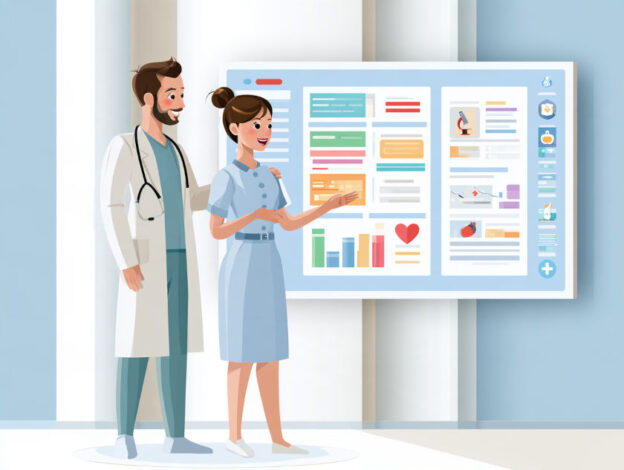
Electronic health records have transformed how medical information is shared, but giving healthcare professionals access to the same data does not necessarily mean they will make sense of it in the same way. New research from the McCombs School of Business at The University of Texas at Austin suggests that digital records can give nurses greater decision-making authority and improve the coordination of patient care, provided medical teams develop a common understanding of the information they use.
The transition from paper charts to electronic health records (EHRs) has taken decades, supported in part by federal financial incentives. By 2021, nine in ten doctors’ offices had adopted the technology. Yet hospitals and clinics are still learning how to make the most of it. Jay Park, assistant professor of management at the McCombs School, found that EHRs allow nurses to take on responsibilities previously handled by physicians. “It becomes more important to be on the same page, to share understandings of that information itself,” Park says.
Working with John Joseph and Daniel Chow of the University of California, Irvine, and Alex James Wilson of the University of North Carolina, Park examined 22,741 patient encounters at a university health system that introduced EHRs in 2013. Two hospitals implemented the system three months apart, creating an opportunity to compare clinical decisions before and after adoption. The results revealed a substantial shift in responsibility. Nurses wrote an average of 55% more medical orders per patient encounter after EHR implementation, while their share of medical decisions rose from 14% to 22%. “We found that doctors delegate work to nurses, and nurses become more equipped to assume their tasks,” Park says.
Greater independence, however, brings new challenges. Doctors and nurses may have access to identical records but interpret them differently, potentially complicating teamwork. The researchers identified three practices that helped clinicians develop shared understanding: working repeatedly with the same colleagues, receiving common training, and regularly using clinical notes. Familiarity with colleagues’ working styles, consistent procedures for tasks such as patient handovers, and a better grasp of individual medical terminology all helped nurses take on more decision-making responsibilities.
The implications extend beyond hospitals. Engineers, marketers and other professionals increasingly rely on shared digital information, yet access alone cannot guarantee effective collaboration. “Even though they have access to the same data, they could interpret it differently, and then they could have coordination problems,” Park says. The findings suggest that organisations investing in information technology must also pay attention to how employees communicate, learn and interpret what they see.
Park now plans to investigate whether artificial intelligence presents similar challenges. AI can rapidly analyse information and make it more accessible, but its outputs may be understood differently by different employees. “An important question is whether AI helps create shared understanding, or it creates more conflict over interpretation. Does it disrupt the decision-making process? I hope to find out.”
More information: John Joseph et al, Information processing, mutual understanding, and organization design in healthcare, Strategic Management Journal. DOI: 10.1002/smj.70116
Journal information: Strategic Management Journal Provided by University of Texas at Austin