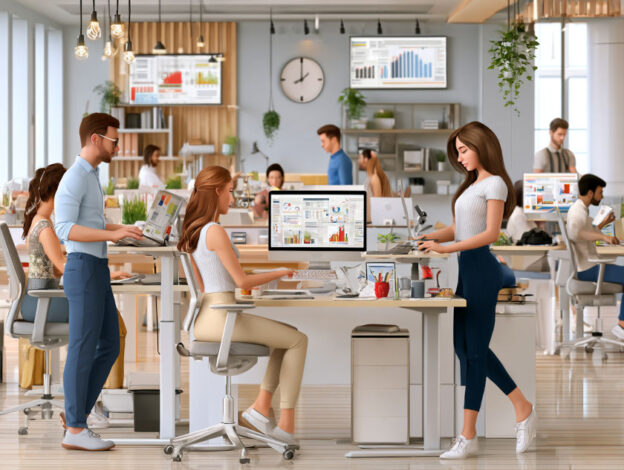
The humble office desk may have more influence over workplace productivity than most employers realise. While businesses invest heavily in technology, training and management strategies to improve performance, new research suggests that something as simple as allowing employees to alternate between sitting and standing could make a significant difference.
Researchers at Texas A&M University analysed data from more than 10,000 employees. They discovered that those using height-adjustable desks recorded an average of 43 additional minutes of active computer use each day compared with workers at conventional desks. Over a year, that difference could represent nearly $9,000 in potential productivity value per employee.
The study, published in Theoretical and Applied Ergonomics, was co-led by Texas A&M professor Dr Mark Benden and US Army ergonomist Dr Tricia Salzar. Their findings highlight what Benden calls the “workplace effect” — the influence of physical surroundings on employee health, behaviour, engagement and performance.
Unlike traditional desks, sit-stand workstations allow employees to change positions throughout the day, potentially reducing physical discomfort associated with prolonged sitting. Researchers believe this flexibility may also help workers maintain energy, concentration and engagement during working hours.
To investigate, the team examined a year’s worth of workplace data, combining employee comfort surveys with computer activity records. The measurements included keystrokes, words typed, mouse clicks and typing errors, providing both subjective feedback and objective indicators of work activity.
The results revealed a notable difference. Employees using adjustable desks averaged 3.66 hours of active computer time daily, compared with 2.95 hours among those using standard desks. That amounts to approximately 171 additional hours annually — equivalent to more than four 40-hour working weeks.
Using a standardised hourly wage of approximately $52, researchers calculated that the additional activity could represent nearly $9,000 in annual productivity value per employee. Adjustable-desk users also generally recorded more keystrokes and typed more words, although increased computer activity does not necessarily mean an equivalent improvement in overall work quality.
“The design of the workplace itself can be a powerful driver of human health and performance, including better engagement, productivity and organisational success,” Benden said. He argues that employers should consider the physical environment alongside technology and management practices when seeking improvements.
The findings also raise questions about how workplaces might evolve as artificial intelligence becomes increasingly integrated into everyday tasks. Benden and his colleagues hope to explore how emerging technologies interact with physical workspaces and whether thoughtful design can further improve employee well-being and organisational performance.
For Benden, who directs Texas A&M’s Center for Worker Health, the broader message is that workplaces should be designed around the people using them. Although the findings demonstrate an association rather than proving that adjustable desks directly cause higher productivity, they offer employers a compelling reason to reconsider the conventional workstation. Sometimes, improving performance may begin not with asking employees to work harder, but with changing where and how they work.
More information: Tricia Lynn Salzar et al, Improved Computer Utilization Associated with Height Adjustable Workstations in a Large Office Population, Theoretical and Applied Ergonomics. DOI: 10.3390/tae2030021
Journal information: Theoretical and Applied Ergonomics Provided by Texas A&M University