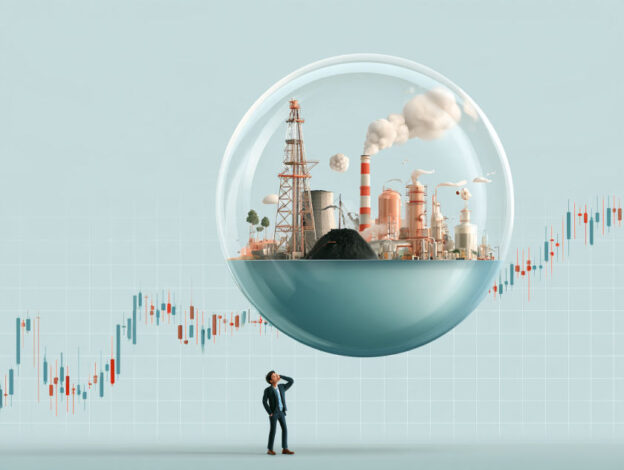
The world’s biggest fossil-fuel companies face an uncertain future as governments tighten climate policies and cleaner energy becomes increasingly competitive. But are investors overestimating the value of coal, oil and gas businesses, leaving financial markets vulnerable to a costly correction?
This concern lies at the heart of the “carbon bubble” debate. Fossil-fuel reserves and infrastructure could lose value as climate policies strengthen and energy demand shifts, potentially exposing companies, investors and financial institutions to substantial losses.
New Australian research, however, suggests the financial threat may be smaller than previously feared. Researchers from the Centre for Climate Risk and Resilience at the University of Technology Sydney (UTS) Business School and Macquarie University estimate the carbon bubble at approximately 5.5% of the market value of the largest US-listed fossil-fuel companies with traded options, equivalent to around US$99.3 billion.
The study examined how financial markets responded to 31 major climate policy developments between 1996 and 2023, including 27 United Nations climate conferences and four significant announcements in the United States and European Union. Using stock and options market data, researchers compared company valuations under business-as-usual conditions with estimates incorporating climate policy risks.
The findings suggest investors have already factored some climate-related risks into fossil-fuel company valuations, challenging predictions of widespread financial losses. Rather than facing an inevitable collapse, companies may experience a more gradual adjustment as the global energy transition unfolds.
“The findings challenge the assumption that stronger climate policies must automatically lead to substantial financial losses for every fossil-fuel company,” said lead researchers Dr Mona Mashhadi Rajabi and Professor Martina Linnenluecke. They emphasised that companies face different levels of exposure depending on their assets, investment strategies and ability to adapt to changing energy markets.
Nevertheless, a relatively modest carbon bubble does not mean the industry is out of danger. Long-term fossil-fuel investments remain vulnerable to shifting demand, tighter regulations and changing project economics. Companies that anticipate these developments and adjust their strategies may be better positioned than those relying on existing market conditions.
The implications are particularly significant for Australia, a major exporter of coal and liquefied natural gas. With export revenues closely tied to international demand, investment decisions must consider how energy markets could evolve over the operating lives of major projects. Clear climate policies and better financial disclosures could also help investors distinguish between businesses preparing for change and those carrying greater risks.
“The carbon bubble debate should move beyond predictions of a sudden collapse. What matters now is whether companies, investors and governments are making decisions that reflect the energy markets of the future, rather than relying solely on the conditions of the past,” the researchers concluded.
More information: Mona Mashhadi Rajabi et al, How big is the carbon bubble really? Sustainable Futures. DOI: 10.1016/j.sftr.2026.102038
Journal information: Sustainable Futures Provided by University of Technology Sydney