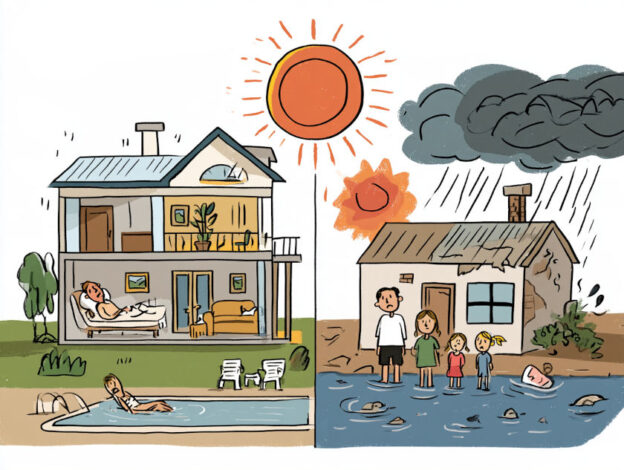
Climate change is not just threatening the environment. It may also be widening the gap between rich and poor, placing an especially heavy burden on those least equipped to cope with its consequences. From extreme weather and disrupted agricultural production to rising energy costs, climate-related pressures can deepen existing economic disparities, particularly in developing economies where vulnerable households often have limited financial protection.
A study published in Sustainable Development examined the relationship between climate change and income inequality in 23 emerging market economies between 2002 and 2022. The researchers found that greater climate pressure was consistently associated with higher income inequality, regardless of how inequality was measured. The findings suggest that environmental deterioration may have consequences extending well beyond ecosystems, affecting how income is distributed across society.
To capture the broader effects of climate change, the researchers developed a composite climate pressure index rather than relying on a single environmental measure. The index combined four factors: greenhouse gas emissions per person, exposure to fine particulate matter, temperature volatility and precipitation volatility. They then examined its relationship with income inequality using three established indicators: the Gini coefficient, the Palma ratio and the Theil index. All three showed a positive association, although the strength of the relationship differed.
Other economic and institutional factors also played a role. Higher per capita income and stronger institutional quality were associated with lower income inequality, while higher unemployment was linked to greater disparities. These findings point to the importance of economic conditions and effective governance in shaping how societies experience climate-related pressures. They also suggest that environmental policies alone may not be sufficient to address the unequal economic consequences of climate change.
The researchers called for climate policies that take income distribution and social justice into account. Targeted social protection programmes could help shield low-income households from extreme weather, agricultural disruptions and volatile energy prices. At the same time, additional assistance could be directed towards regions facing particularly high climate risks. Creating employment opportunities in renewable energy, energy efficiency and climate adaptation infrastructure, especially for low-skilled workers, could also help ensure that the transition towards a greener economy does not leave vulnerable groups behind.
“Climate change should not be viewed solely as an environmental challenge; it is also closely connected to the question of how economic risks and opportunities are distributed across society,” said corresponding author Umut Üzar, PhD, of Karadeniz Technical University in Turkey. “Our findings underscore the importance of placing income inequality and social justice at the heart of climate policy, particularly in emerging economies where vulnerable populations may face disproportionate risks.”
More information: Umut Uzar et al, A Neglected Dimension of Climate Change: Does Climate Change Deepen Income Inequality? New Evidence From Emerging Economies, Sustainable Development. DOI: 10.1002/sd.71880
Journal information: Sustainable Development Provided by Wiley